The Joy of Jesus Bible
The Watchman Who Argued With God
Habakkuk 1-3 · already not yet
About a hundred years after Micah, a prophet named Habakkuk looked around Jerusalem for anyone who did what was right, loved mercy, and walked humbly with God. He could hardly find one.
Rich men grabbed from poor men. Judges took money and let cheaters win. God's law lay around like a broken tool nobody bothered to pick up.
So Habakkuk took it up with God.
"How long, LORD?" he cried. "I keep calling for help, and you don't listen! I shout 'Violence!' and you don't save anyone. Why do you make me watch all this?"
God answered. "Look at the nations and be amazed. I am going to do something in your days that you would not believe, even if someone told you. I am raising up the Babylonians."
The Babylonians had horses faster than leopards. Their soldiers laughed at kings and scooped up prisoners like handfuls of sand. God was sending them to punish Judah.
"But LORD," Habakkuk said, "you are holy! You can't stand to look at evil. So why use people who are even worse than us? They catch whole nations like fish in a net, and then they burn incense to the net!"
(Imagine a fisherman thanking his net for the fish, instead of the God who made the fish.)
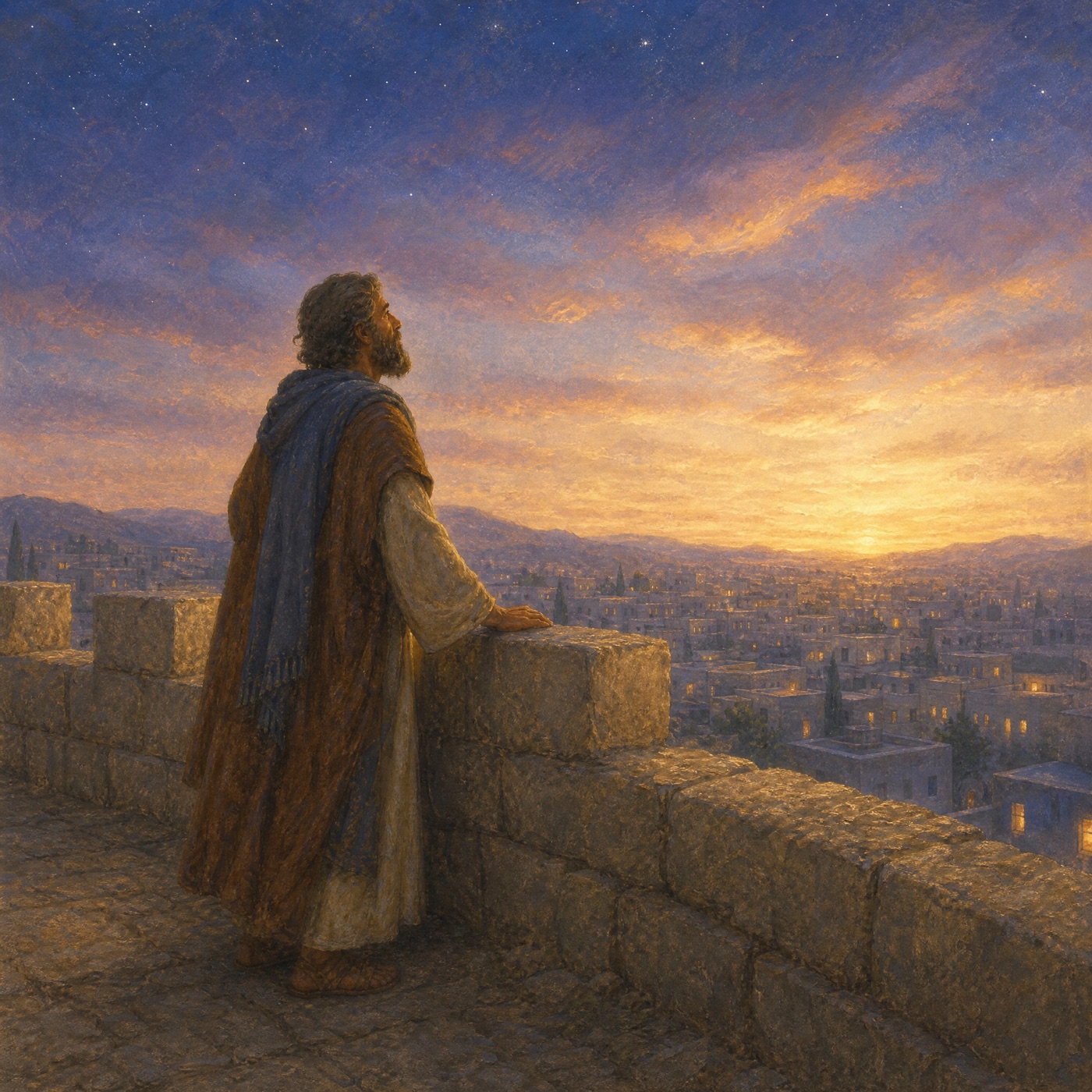
Habakkuk climbed onto the city wall. In those days a watchman stood there all night, looking out for enemies, or for a messenger running with news. "I will stand at my post," Habakkuk said, "and watch to see what God will say to me, and how I will answer him."
God answered him there. "Write down what I show you. Make it plain on tablets, so a runner can read it and carry it. If it seems slow, wait for it. It will surely come, and it will not be late. The proud are crooked inside, but the righteous will live by faith."
Babylon's turn would come too, God said. Anyone who carves a god out of wood and says to it, "Wake up!" would find out that wood stays wood. (It has never once woken up.)
"But the earth will be filled with knowing the glory of the LORD," God said, "as the waters fill the sea."
Habakkuk wrote a song. He sang about God rescuing his people long ago, when the mountains shook. His heart still pounded and his knees wobbled. But he said, "I will wait for God's day," and he sang anyway:
Even if the fig tree has no figs
and the vine has no grapes,
even if there are no sheep in the pen
and no cows in the barn,
I will still be glad in the LORD.
I will be joyful in God my Savior.
He makes my feet like a deer's feet
and takes me up to the high places.
Habakkuk's song did not stop the Babylonians. They came, just as God had said, and burned Jerusalem. Babylon fell too, years later, but the wrong things kept happening for more than five hundred years, and God's people kept watching and waiting.
Then one dark afternoon another man hung on a cross outside Jerusalem and cried out to God, "My God, my God, why have you left me?" Even then he trusted his Father. "Father, into your hands I give my spirit," he said, and he died. God's answer did not come written on a tablet. It came running, at dawn on the third day, when women raced from an empty tomb with the news that Jesus was alive. The sea of glory Habakkuk saw coming had begun to rise, and it is rising still.
···