The Joy of Jesus Bible
The City That Sat Down and Cried
Lamentations 1-2 · gods heart
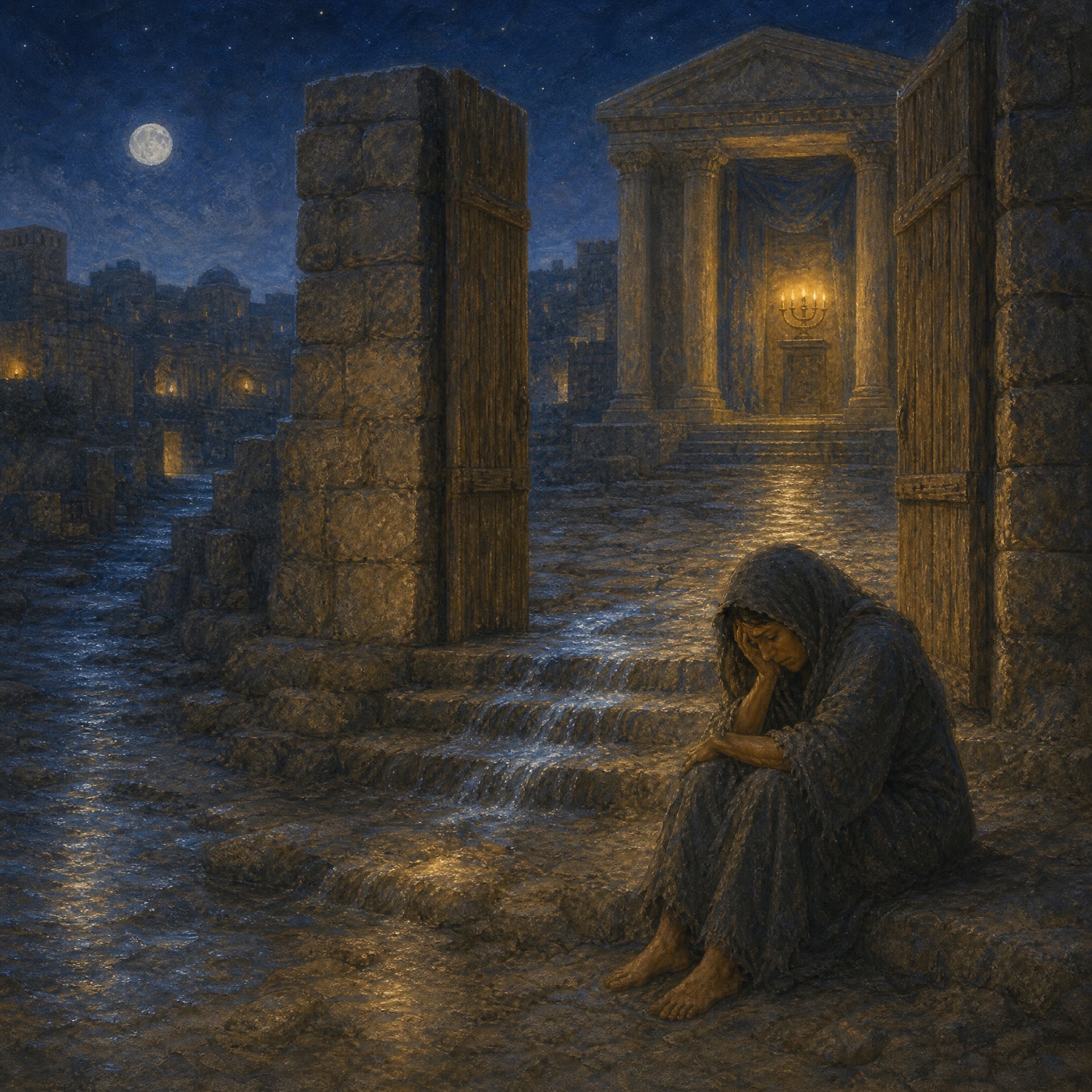
The smoke was still rising over Jerusalem
when a man sat down in the ashes
and began to write a song.
(Many people think it was Jeremiah,
the prophet who had warned the city for forty years.)
"Look how she sits all by herself," he wrote,
"the city that used to be crowded with people.
She was a princess among the nations.
Now she is like a widow
and the princess has become a slave."
She cries all night long.
The tears stay wet on her cheeks.
The friends she trusted more than God
have run off, or turned into enemies,
and there is no one to comfort her.
The roads to the feasts are empty.
The gates have sunk into the ground.
The old men sit on the ground in silence
with dust on their heads,
and the girls bow their faces to the dirt.
(He wrote his song in alphabet order,
one verse for each letter in Hebrew,
as if he had to name every sadness
from the first letter to the last.)
Then the city herself calls out to the road:
"Is it nothing to you, all you who pass by?
Look and see!
Is there any sorrow like my sorrow?"
Her walls were broken,
and soldiers marched her people away as prisoners to Babylon.
Strangers marched into God's house,
where no stranger was ever allowed.
Priests and prophets were killed there.
Boys and old men lay dead in the dusty streets.
Children fainted from hunger in the squares.
"Mama, where is the bread?" they cried,
and some of them died in their mothers' arms.
The poet cried until his eyes gave out.
Why did it happen?
The city answered that herself:
"The LORD is right.
I turned against his word."
For years her prophets had told her pretty stories.
"Everything will be fine!"
Not one of them told her the truth about her sin.
But God had warned her long ago,
and now his anger burned against her like fire.
He did what he had said.
People walking past clapped their hands
and shook their heads.
"Is this the city they called so beautiful,
the joy of the whole earth?"
Her enemies hissed and laughed.
"We swallowed her up!
This is the day we were waiting for!"
So the poet gave the city one thing to do.
"Get up! Cry out in the night!
Pour out your heart like water
in front of the Lord.
Lift your hands to him
for the lives of your children."
The city had no comfort left.
She still had someone to cry to.
But tears could not stand the walls back up,
and they could not bring one child home.
The captives came home at last.
A new temple rose, and then new walls,
and still God's people waited
for someone to comfort Jerusalem.
Then, beside a road just outside the city,
a man who had once cried over Jerusalem
was put to death on a cross.
The people passing by shook their heads at him,
the way they once shook their heads at Jerusalem.
Nearly all his friends had run away.
The anger that had burned the city like fire
fell on him, so it would not fall on God's people.
Was there ever any sorrow like his sorrow?
The night before that hill,
he had told his friends,
"I will not leave you all alone.
I will come to you."
The man on that hill was Jesus,
and he is the comfort the city cried for.
···