The Joy of Jesus Bible
A Seat at the King's Table for Jonathan's Son
2 Samuel 9 · gods heart
The wars were won, and God had promised David a house that would last forever. Now the king sat in his palace and thought about a promise he had made long ago to his best friend.
Jonathan was King Saul's son, and he had loved David like a brother, even while Saul chased David through the hills trying to kill him. "Never stop being kind to my family," Jonathan had begged. David promised. Then Saul and Jonathan both died in one battle on Mount Gilboa.
"Is there anyone left from Saul's family?" David asked. "Anyone I can be kind to, for Jonathan's sake?"
Someone found an old servant of Saul's named Ziba and brought him in.
"Are you Ziba?" said the king.
"I am your servant."
"Is anyone left? I want to show him the kindness of God."
Ziba nodded. "Jonathan has a son. His feet are lame."
That son was Mephibosheth. He had been five years old on the day the news came that his father and grandfather were dead. His nurse snatched him up and ran, and in her hurry she dropped him. His feet were hurt, and they never got better.
(In those days, when a new king took the throne, he often killed everyone in the old king's family, so no one could ever try to take the crown back. Everybody knew it. Mephibosheth knew it best of all.)
"Where is he?" asked David.
"In Lo-debar, at the house of a man named Machir."
Lo-debar means "no pasture." (Picture a town called Nothing-Grows-Here, far from everything, which is exactly the sort of place a person picks for hiding.) Mephibosheth was a grown man by now, with a young son of his own named Mica. Then the king's men knocked at Machir's door.
They carried him all the way up to Jerusalem. He was sure he knew how this would end.
In front of the king, Mephibosheth fell on his face.
"Mephibosheth!" said David.
"I am your servant," he whispered.
"Don't be afraid," said David. "I will be kind to you, because I loved your father Jonathan. I am giving you back all the land that belonged to your grandfather Saul. And you will eat at my table, always."
Mephibosheth bowed again. "Why would you even look at a dead dog like me?"
David called Ziba back. "Everything that belonged to Saul now belongs to Jonathan's son. You and your sons and your servants will farm it for him." Ziba had fifteen sons and twenty servants. (Counting Ziba, that is thirty-six farmers for one man who would never have to pick up a hoe.)
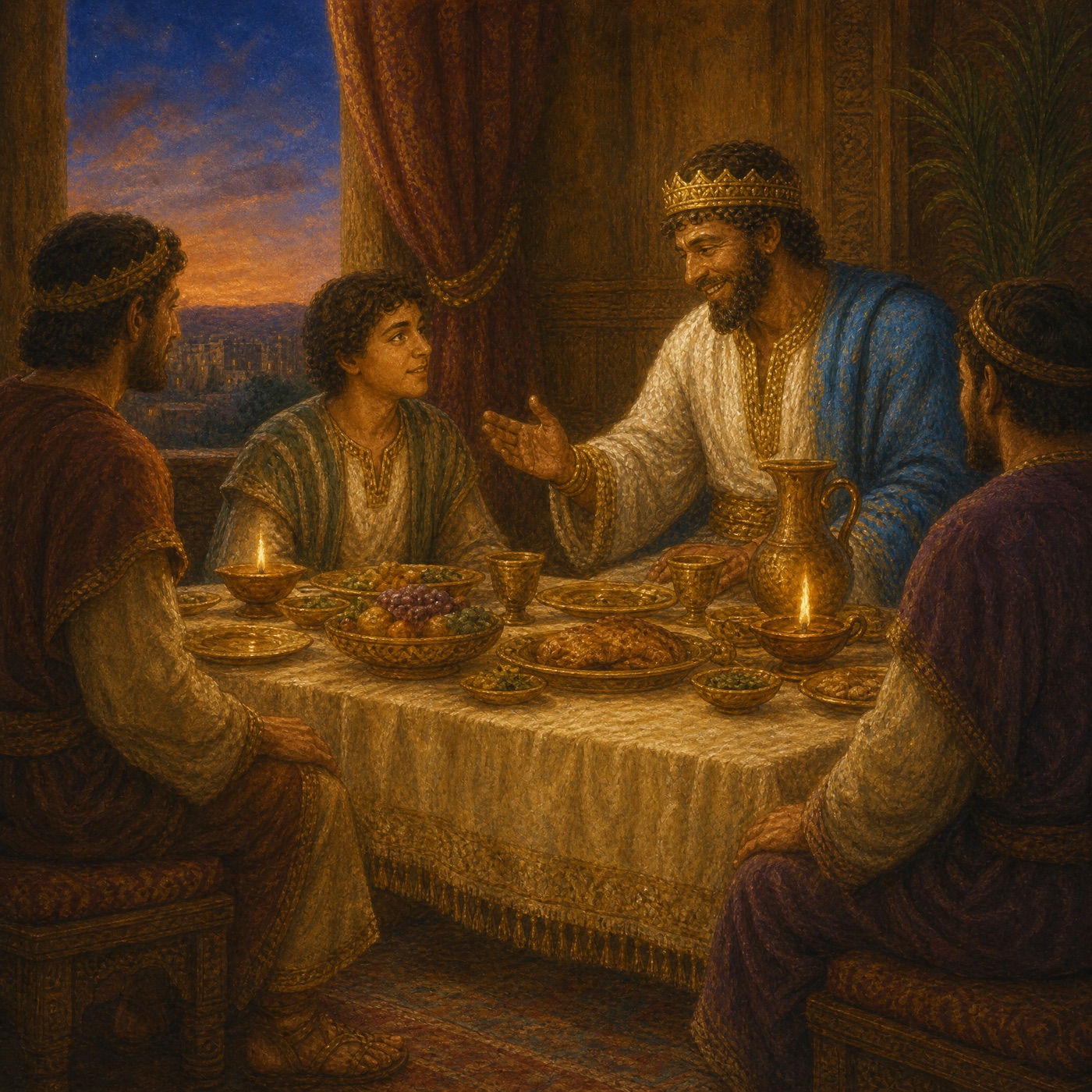
So Mephibosheth moved to Jerusalem, and every evening he ate at King David's table like one of the king's own sons. He had come expecting a sword and got a chair. The Bible ends the story by saying he was still lame in both feet. He did not have to be fixed before he could sit down. He was carried in just as he was.
David's table had room for one lame man and his little son. A king could give a lame man a chair. He could not give him new feet.
Many years later, a man from David's family came who could do both. He made lame men jump to their feet. He ate supper with people everyone else had crossed off the list. "When you give a feast," he said, "invite the poor, the crippled, the lame, and the blind." To frightened people he said, "Do not be afraid." And he made a way for people who had been God's enemies to sit at God's table as sons and daughters.
Jesus is still filling chairs at that table.
···