The Joy of Jesus Bible
A Promise Written Inside Your Heart
Jeremiah 31:31-34 · promise keeping
Years after the morning at the potter's house, Jeremiah was still carrying God's warnings through the streets of Jerusalem, and the people were still covering their ears. Babylon had already marched thousands of them away to a far country. Soon its army would come back for the city itself.
Then God gave Jeremiah a new job. "Write in a book all the words I have spoken to you," he said. "The days are coming when I will bring my people home."
So Jeremiah wrote. (A book then was one long strip of leather or reed paper, rolled up tight like a very serious paper towel.)
God showed him his people coming home, with girls dancing and old men laughing in Jerusalem's streets. Jeremiah woke up and said his sleep had been sweet. (For a prophet who mostly carried bad news, that was a very good night.)
But in those sad days the people had a grumble they liked to repeat. "Our fathers ate the sour grapes," they said, "and now our teeth are the ones that hurt!" They meant the mess was their parents' fault. God said that one day they would stop saying it, because whoever eats the sour grapes is the one who gets the sore teeth. The trouble was in every heart, theirs too.
"The days are coming," says the LORD,
"when I will make a new promise with my people.
It will not be like the promise I made with their ancestors
when I took them by the hand and led them out of Egypt.
They broke that promise,
though I was a husband to them."
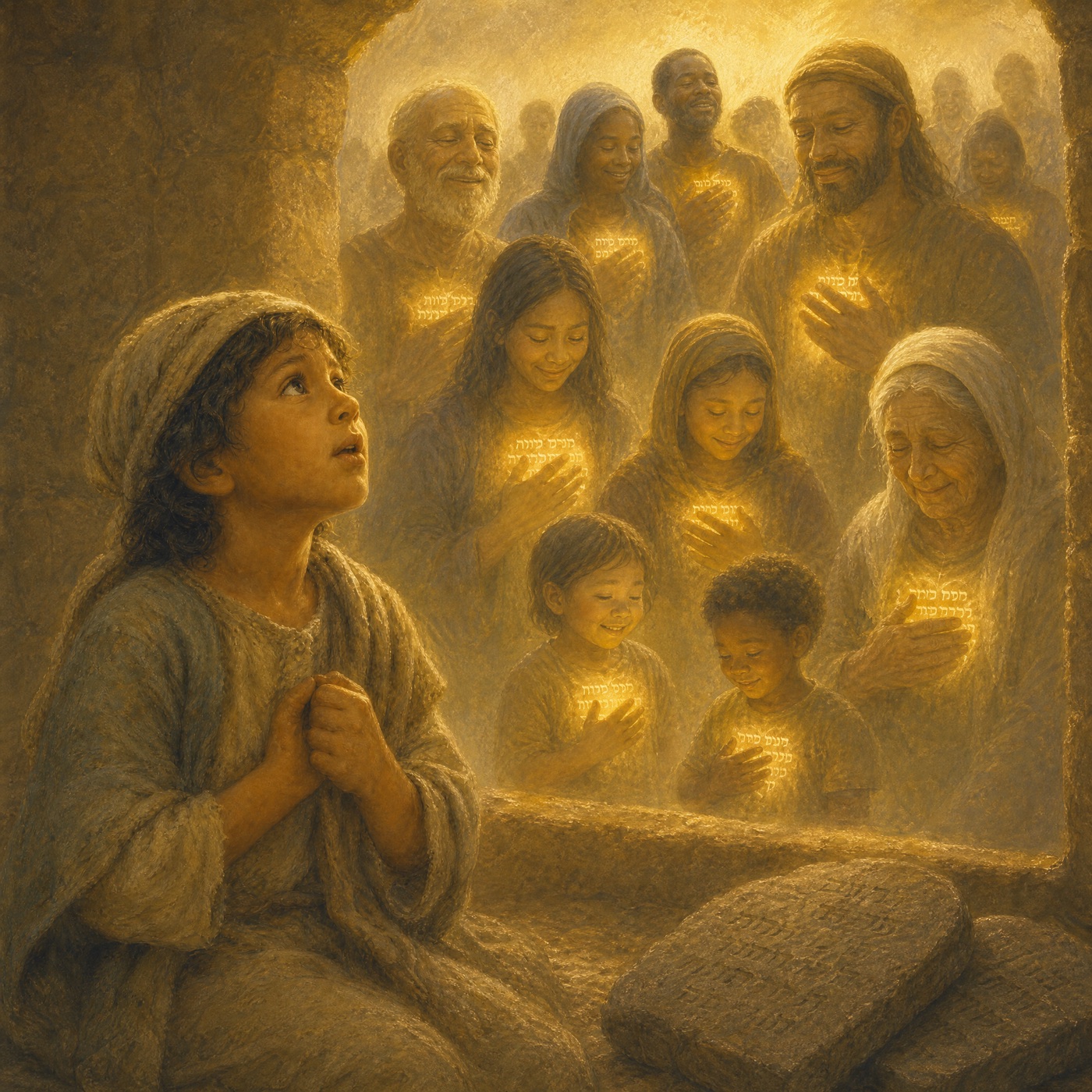
At Mount Sinai God had written his law on two flat stones, and his people had promised to belong to him and no other god, the way a wife promises to belong to her husband and no one else. Then they ran after other gods and broke it, again and again. The words stayed on the stones, outside them. (Stone is very good at keeping words. It is no good at all at making anyone love them.)
"This is the new promise," says the LORD.
"I will put my law inside them.
I will write it on their hearts.
I will be their God,
and they will be my people.
No one will need to tell a neighbour, 'Know the LORD!'
because they will all know me,
from the least of them to the greatest.
I will forgive their wickedness,
and I will remember their sins no more."
But a promise on a scroll is still ink on the outside. Jerusalem fell, Babylon burned the temple, and hearts stayed as hard as ever. In the far country, God's people read Jeremiah's scroll and waited.
Six hundred years after Jeremiah, on a spring night in Jerusalem, a man sat at supper with twelve friends, ready to do what no stone and no scroll could do. He lifted a cup of wine. "This cup is the new promise in my blood," he said, "poured out for you."
The next day he died on a cross so that every sin could be forgiven and remembered no more. On the third day he rose, and he sent God's Spirit to write on his people's hearts.
Jeremiah had written the promise in ink on a scroll. Jesus signed it with his own blood.
···