The Joy of Jesus Bible
The River That Held Its Breath
Joshua 3-4 · type true and better
The two spies slid down a rope from Rahab's window, hid in the hills for three days, and hurried back across the river to Joshua. "The LORD has given us the whole land!" they said. "The people over there are so afraid of us their knees have turned to water."
Early the next morning, Joshua marched the whole camp down to the bank of the Jordan, and there they stopped.
It was harvest time, when the mountain snow melts, and the Jordan had spilled over its banks, brown and fast and much too deep to wade. There was no bridge. There were babies and grandmothers, sheep and goats, tents and cooking pots, and every one of them had to get to the other side.
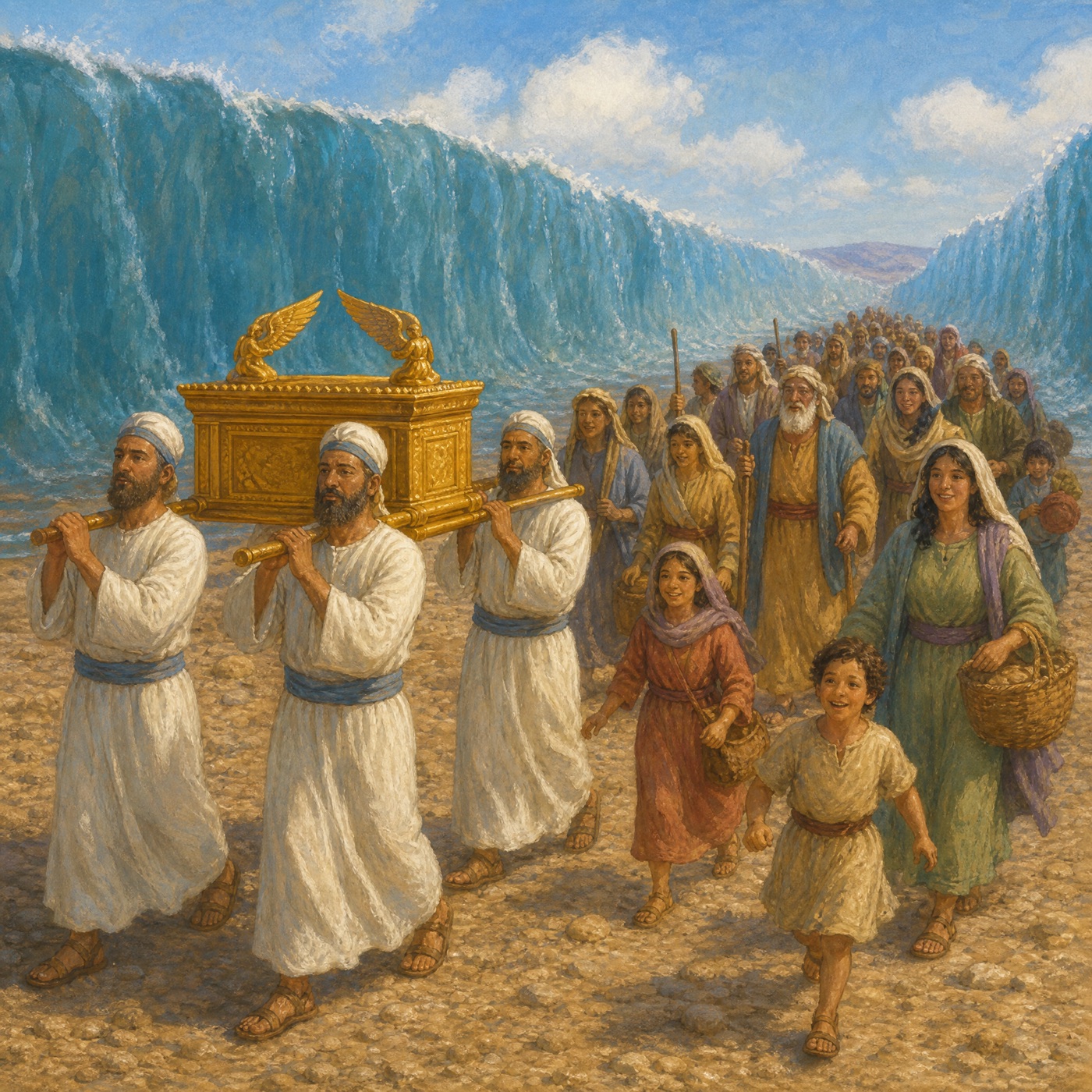
For three days they camped and stared at the water. Then Joshua's officers went through the camp with orders about the ark, the gold-covered chest that held God's Ten Commandments. "When the priests carry out the ark of the LORD, follow it," they said. "Stay far back, so everyone can see the way. You have never been this way before."
(Far back meant about ten soccer fields away. A crowd that big can only follow what it can see.)
The LORD spoke to Joshua. "Today I will begin to make you great in the eyes of all Israel, so they will know that I am with you as I was with Moses. Tell the priests who carry the ark: when you reach the edge of the water, go and stand in the Jordan."
In the morning the priests lifted the ark onto their shoulders and walked down to the rushing water. They did not stop at the edge. Their feet splashed in, and the river stopped.
Far upstream, beside a town called Adam, the water piled up in one great heap. Downstream, the rest drained away to the Salt Sea. Where the Jordan had roared, there was dry ground.
The priests walked to the middle and stood still. Then the people crossed: fathers with toddlers on their backs, old men with walking sticks, forty thousand soldiers marching in rows. Children kicked at pebbles that had been underwater at breakfast. (Nobody's sandals even got muddy.) The priests stood there until the very last family had climbed out on the far side.
Joshua sent twelve men, one from each tribe, back to the middle. "Each of you lift a stone onto your shoulder and carry it out," he said. "Someday your children will ask, 'What do these stones mean?' Then tell them, 'The water of the Jordan stopped in front of the ark of the LORD.'"
At last Joshua called to the priests, "Come up out of the Jordan!" The moment their feet touched the bank, the river let out its breath, and back came the water, rushing over its banks just as before. That night, at Gilgal near Jericho, Joshua piled up the twelve stones.
But the Jordan only stopped for one day. And everyone who crossed it still had a deeper river ahead, the one called death, which no priest's feet can stop.
The stones stood at Gilgal, and children kept asking what they meant. Many years later, crowds came down to that same river to be baptized by a man named John, and another man waded into the Jordan. He would go ahead of God's people into death itself, and on the third day he would come up out of it alive, making a way through for everyone who follows him.
That man was Jesus, and like the priests in the riverbed, he holds the way open until the last of his people is across.
···