The Joy of Jesus Bible
The Long Road Home and the First Stones
Ezra 1-3 · promise keeping
The king who could not sleep, and ended up honoring Mordecai, was not the first Persian king to help God's people. The first was Cyrus, years earlier, when his army took Babylon.
Babylon had dragged God's people far away, almost seventy years before, and later burned Jerusalem and its temple to the ground. But God had made a promise through the prophet Jeremiah: "When seventy years are over, I will bring you back to this place." Through the prophet Isaiah, long before Cyrus was born, God had even called him by name.
Now God stirred up Cyrus's heart, and the king sent a message across his empire:
"This is what Cyrus king of Persia says. The LORD, the God of heaven, has given me all the kingdoms of the earth, and he has chosen me to build him a house in Jerusalem. Any of his people may go up and build it, and their neighbors must give them silver, gold, and animals for the trip!"
(Conquering kings did not usually send their captives home with presents. This one did.)
Then Cyrus's treasurer brought out the gold and silver dishes Babylon had stolen from God's temple and counted them into the hands of Sheshbazzar, the leader of Judah. "Thirty gold dishes. A thousand silver dishes. Twenty-nine pans..." He kept counting until he reached five thousand four hundred.
More than forty-two thousand people set out, with two hundred singers. They took 736 horses, 245 mules, 435 camels, and 6,720 donkeys. (Camels groan every time someone loads them, so that was a lot of groaning before breakfast.) Grandparents walked beside the children and pointed ahead. "There was a gate there, and a temple on the hill, with gold inside!"
When they reached Jerusalem, black stones lay in the weeds where the temple had stood. The people living nearby watched with narrow eyes, and the families were afraid.
In the seventh month, everyone gathered in Jerusalem as if they were one person. Joshua the high priest and Zerubbabel, from King David's family, made the plan. "Before walls, before a roof, we build the altar."
They set it on its old spot, and every morning and every evening the smoke of the offerings rose again, as Moses' Law said. They kept the Feast of Shelters too, living for a week in huts made of branches.
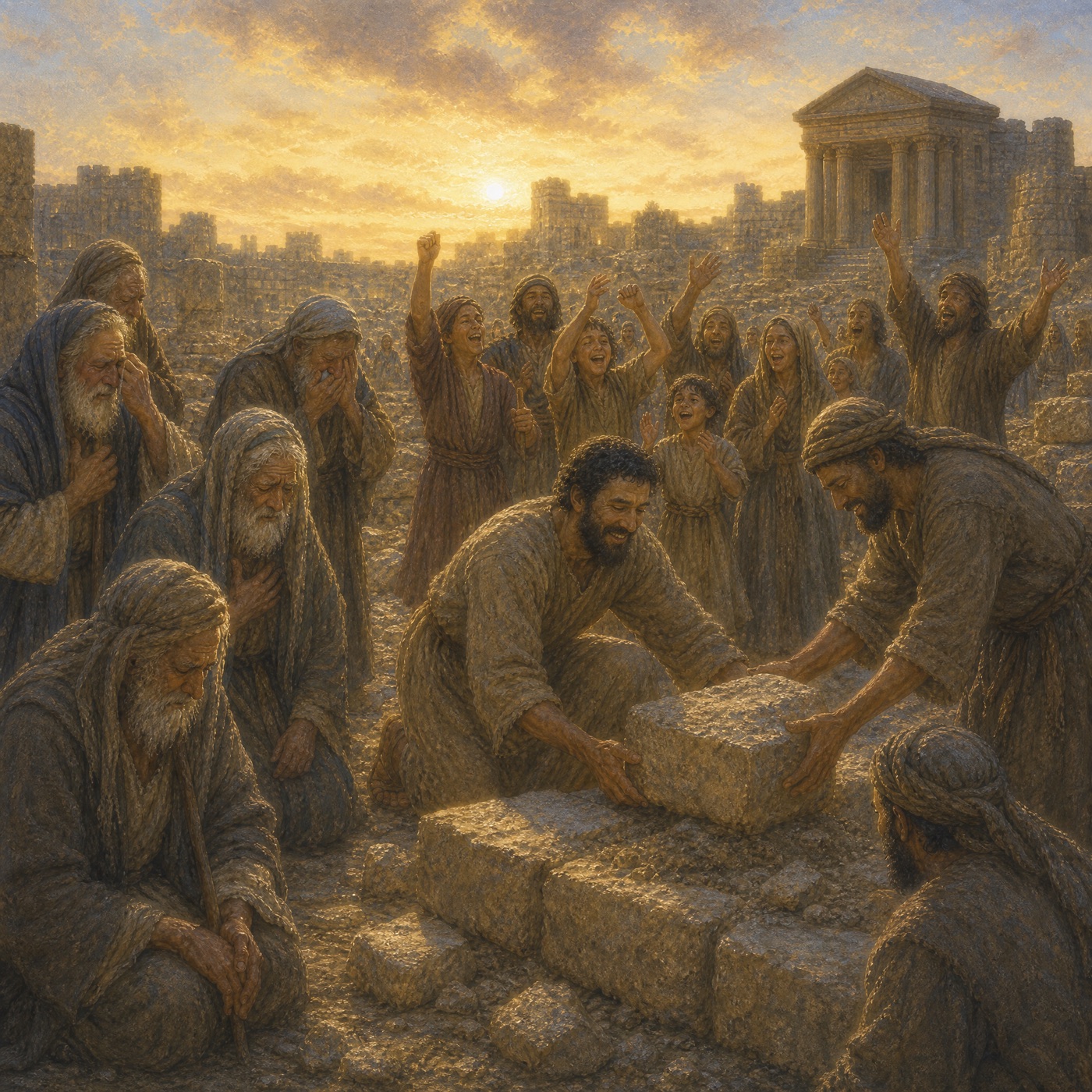
In the second year, the builders laid the foundation of the LORD's house. The priests stood in their robes with trumpets. The Levites crashed their cymbals. And everyone sang to the LORD:
"He is good! His love for Israel lasts forever!"
The shout carried far away.
But stones that can be stacked can be knocked down, and these families had seen it happen. A house of rock could not keep God's people close to him for good.
Their grandchildren kept building, and hundreds of years later that temple on the hill was bigger and grander than ever.
One Passover, a carpenter's son from Nazareth stood in that temple and said, "Destroy this temple, and in three days I will raise it up." The leaders stared at him. "This temple has taken forty-six years to build, and you will raise it in three days?" But he meant another temple: his own body, where God had come to live among his people. They killed him on a cross. On the third day God raised him up, and now Jesus is building a house out of people instead of stones.
···