The Joy of Jesus Bible
The Day the Doorposts Shook
Isaiah 6:1-8 · gods heart
King Uzziah ruled Judah for fifty-two years, and for most of them he was a strong king who built towers and dug wells. Then he grew proud. One day he marched into God's temple to burn incense on the altar, a job God had given only to the priests.
"Stop!" the priests said. "This is not for you!"
Uzziah stood there with the incense pan in his hand, shouting at them, and right there on his forehead a skin disease broke out, the same scaly kind Naaman the general once had. Uzziah lived in a house by himself until he died, and he was never allowed into God's temple again.
In the year King Uzziah died, God let a man named Isaiah see the real King.
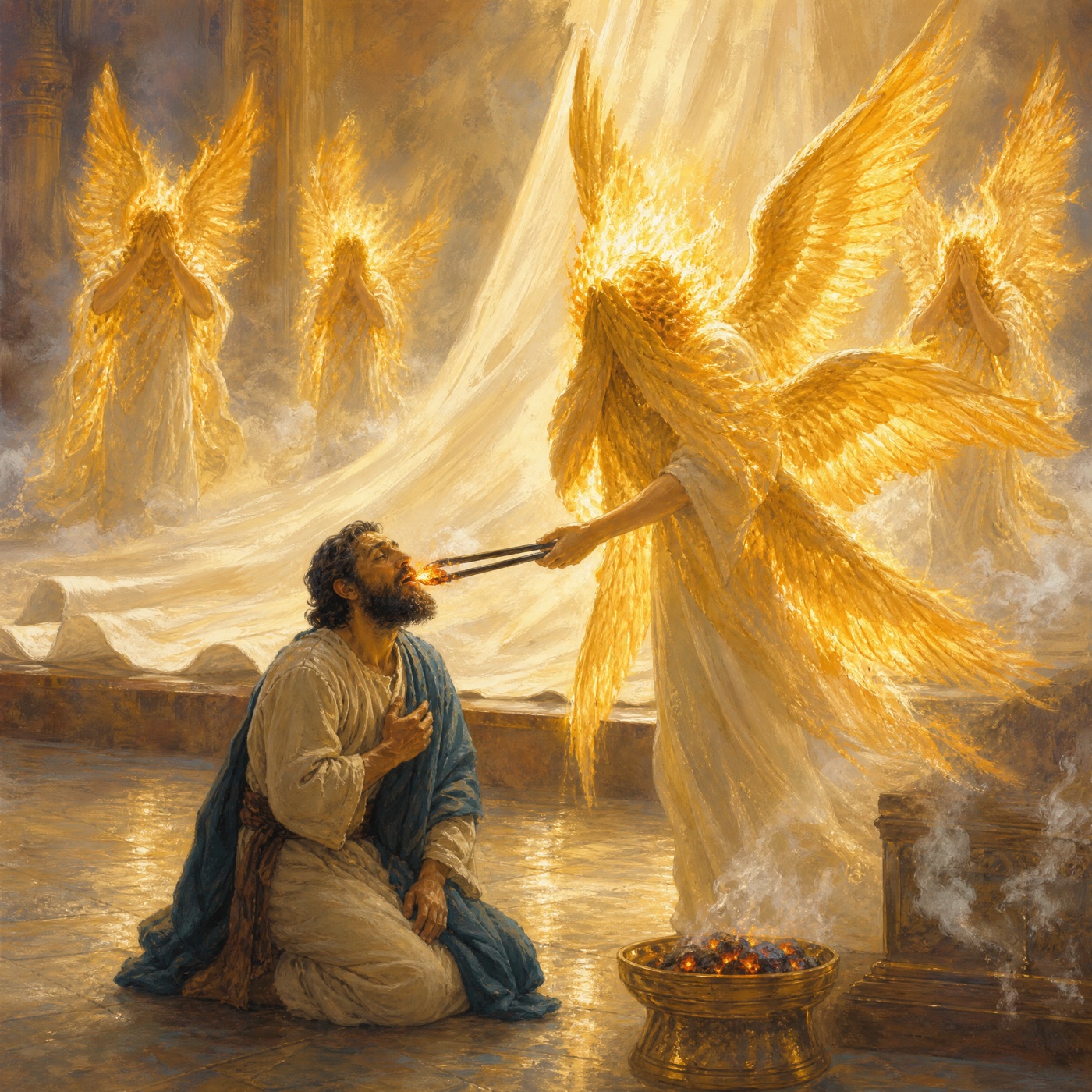
Isaiah saw the Lord sitting on a throne, high and lifted up, in his temple. (Kings in those days wore long robes to show how great they were. This robe was so long that the bottom edge of it filled the whole temple.)
Above him stood the seraphim. Their name means "burning ones." Each had six wings. With two they covered their faces, with two they covered their feet, and with two they flew. They called back and forth to one another:
"Holy, holy, holy is the LORD of hosts!
The whole earth is full of his glory!"
(Hosts means armies. The LORD of hosts is the Lord of all the armies of heaven.) At the sound of their voices the doorposts shook, and the temple filled with smoke.
Isaiah did not join the song. "Woe is me!" he cried. "I am lost! I am a man with unclean lips, and I live among a people with unclean lips, and my eyes have seen the King, the LORD of hosts!"
Unclean lips means a mouth that has said wrong things. Isaiah could remember every one of his. Uzziah had come near God's altar proud, and he went out sick. Isaiah stood near God's throne, afraid, and waited.
Then one of the seraphim flew to him. In its hand was a burning coal, taken from God's altar with tongs. (Even a burning one used tongs for that coal.) It touched the coal to Isaiah's mouth.
"See," it said, "this has touched your lips. Your guilt is taken away. Your sin is covered."
Then Isaiah heard the voice of the Lord. "Whom shall I send? Who will go for us?"
"Here I am!" said Isaiah. "Send me!" And God sent him to carry his words to the people.
A moment earlier he had said he was lost. Now his hand was up first.
One coal could clean one man's mouth, and Isaiah still lived among a people with unclean lips. The priests kept the altar fire burning year after year, and the sacrifices never stopped. Kings came after Uzziah, some good and some proud, and none of them was the King on that high throne.
God was still asking, "Whom shall I send?" At last he sent another, someone who came down from that high throne himself. He needed no tongs. When four friends lowered a man who could not walk down through a roof, right to his feet, he looked at the man and said, "Son, your sins are forgiven," the same news the burning one had brought to Isaiah.
Years later the apostle John, one of this man's closest friends, wrote that Isaiah had seen his glory and spoken about him. The King on the high throne was Jesus.
···