The Joy of Jesus Bible
Let Fairness Roll Like a River
Amos 5:21-24 · gods heart
Joel had promised that one day
God would pour out his Spirit like rain.
But up in the hills of Judah,
a farmer named Amos had a message for right now.
He was minding his sheep and tending his fig trees
when God said, "Go. Speak to my people Israel."
So Amos walked north into Israel.
The rich there had a winter house and a summer house,
beds trimmed with ivory,
and wine by the bowlful.
At Bethel, the king's shrine, the feast days were packed.
Harps twanged and singers sang.
Smoke from the offerings rolled up into the sky.
But down at the town gate,
the judges held out their hands for bribes.
(In those days the gate was the courtroom.
Judges sat there to settle quarrels,
the way a teacher settles who had the swing first.)
A poor farmer with no coins to give
lost his case every time.
Shopkeepers rigged their scales
so half a sack of grain cost the price of a whole one.
If a poor man owed them for a pair of sandals,
they sold him as a slave for a little silver.
Amos stood up in the crowd and shouted,
"Listen, you cows of Bashan!"
He meant the rich ladies of Samaria
who crushed the poor
and called to their husbands, "Bring us something to drink!"
(Amos was a farmer.
He knew a well-fed cow when he saw one.)
Then Amos gave them God's own words:
"I hate your feast days.
I cannot stand your gatherings.
Bring me your offerings,
and I still will not accept them.
Take away the noise of your songs!
I will not listen to your harps.
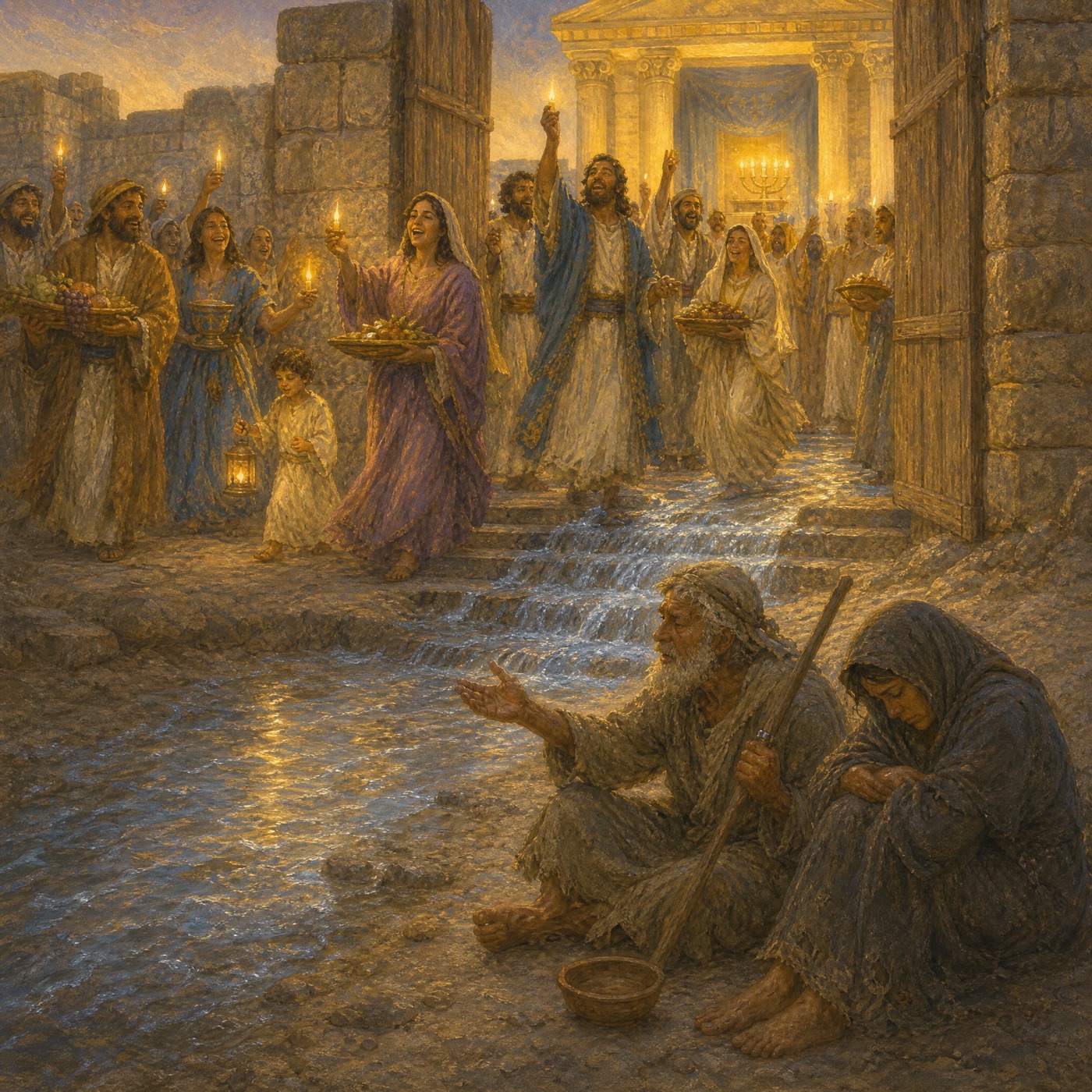
Instead, let fairness roll down like a river,
and doing right like a stream that never runs dry."
(In Amos's hills, most streams dried up by summer
and left a ditch of hot stones.
God wanted one that kept running all year.)
Amaziah, the priest of Bethel, was furious.
"Go home, you seer!" he snapped.
"Run back to Judah and do your preaching there.
This is the king's shrine!"
"I am not a prophet," said Amos.
"I am a shepherd, and I take care of fig trees.
But the LORD took me from following my flock
and told me, 'Go, speak to my people.'"
Still, Amos could only shout about the river.
He could not make it run.
Israel kept its harps and its crooked scales,
and less than forty years later an army from Assyria
marched its people away from their ivory beds.
For hundreds of years, God's people kept Amos's words
and waited for someone who could.
Then, at Passover time in Jerusalem,
with the temple courts full of buyers and sellers,
a man tipped over the money changers' tables.
Coins went rolling across the stones.
"My house will be called a house of prayer for all nations," he said,
"but you have made it a den of robbers!"
He was sold for thirty silver coins,
the way the poor were sold in Amos's day.
Men who did not care what was fair judged him,
nailed him to a cross outside the city gate,
and there he died.
On the third day he rose,
and soon his Spirit came pouring down, as Joel had promised.
His friends shared their bread and their money
until no one among them was in need.
Amos's river had started to run.
His name is Jesus,
and the river runs from him.
···