The Joy of Jesus Bible
Let Everything That Breathes Say Thank You
Psalm 150 · already not yet
The last song in the book of Psalms is the loudest one.
God's people collected their songs for hundreds of years. King David wrote many of them, some out on the hills with his sheep. The temple singers wrote more. Some are glad, a lot are crying songs, and some are waiting songs that ask God, "How long?" When there were a hundred and fifty, the people who gathered the book saved this one for the end, the way you save the biggest firework for last.
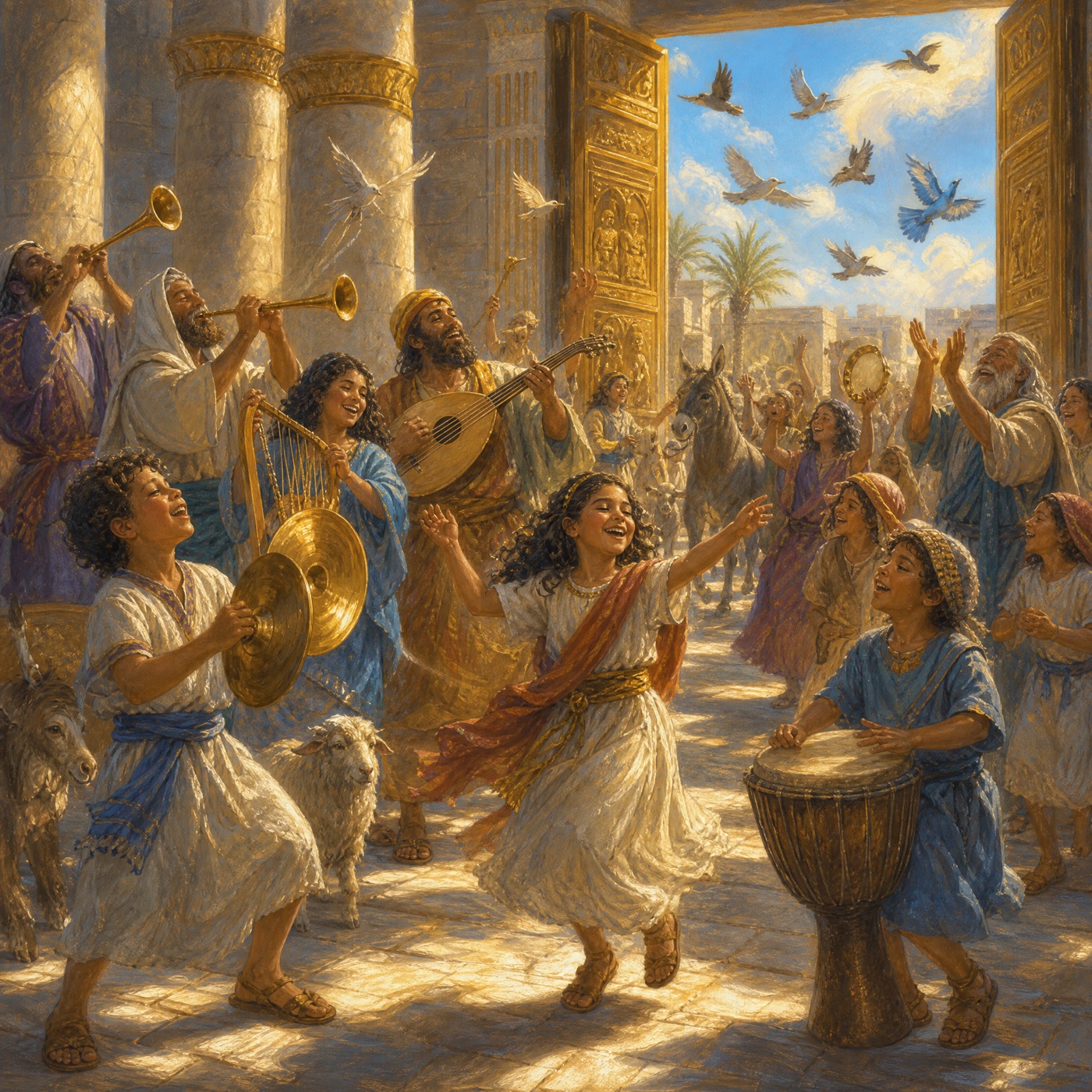
It was sung at the temple in Jerusalem by the Levites, the family God chose to lead the music, with their harps and horns and cymbals. (King David had set them up in teams, fathers beside their sons and teachers beside their students, so there was always somebody old enough to know how the song went.)
The song starts with one word, Hallelujah, which means "Praise the LORD!" Then it keeps on saying it.
Praise God in his holy house!
Praise him in the high, wide sky he spread out!
Praise him for the mighty things he has done!
Praise him, for no one is as great as he is!
Praise him with the ram's horn, long and loud!
Praise him with the harp and the lyre!
Praise him with the drum and with dancing!
Praise him with the strings and the pipe!
Praise him with the crashing cymbals!
Praise him with the clanging, banging cymbals!
A ram's horn is a real horn from a real ram, hollowed out, and it does not sound like a flute. It honks. (The song also asks for two kinds of cymbals, loud ones and even louder ones. Whoever wrote it was not worried about waking the baby.)
Then the song looks past the temple walls and out over the whole world.
Let everything that breathes
praise the LORD!
Hallelujah!
That means the shepherd and the baker. It means the grandmother who can only hum now and the baby who can only squeal. It means the sparrow on the roof, the donkey in the street, the lion in the hills, and the whale blowing spray at the top of the sea. Everything that takes a breath is called into the song, because every breath came from God. When he made the first man out of dust, he breathed into him, and Adam sat up alive.
But singers run out of breath. Each song at the temple ended, and the horns were wiped and hung up. One by one the singers grew old and died, and God's people kept singing the old book and waiting for the King its songs had hoped for.
Hundreds of years later, on his last night, a man from King David's family sang psalms with his friends. The next day, on a cross, he breathed his last and died. On the third day he was breathing again. He came to his friends, breathed on them, and said, "Receive the Holy Spirit."
With his breath in them, his friends began to praise God, and the song of everything that breathes has not stopped since. Grandmothers hum it in the kitchen, babies squeal it in church, and it is sung all over the world. One day every creature in heaven and on earth and in the sea will join in, singing together to God on his throne and to the Lamb. On that day the last psalm will be sung the way it was written, by everything that breathes, to Jesus.
···